
Generational Transition with an Unchanged Mission
Hungarian Interchurch Aid Elects New President at Its 35th Anniversary General Assembly
On 27 May, Hungarian Interchurch Aid (HIA) held its annual general assembly at its headquarters in Budapest. Attended by representatives of the founding churches, as well as the organisation’s leadership and staff, the event extended beyond the approval of annual reports, as the 35th anniversary of the organisation’s founding offered speakers not only a 12-month perspective, but also an opportunity to reflect on three and a half decades of service.
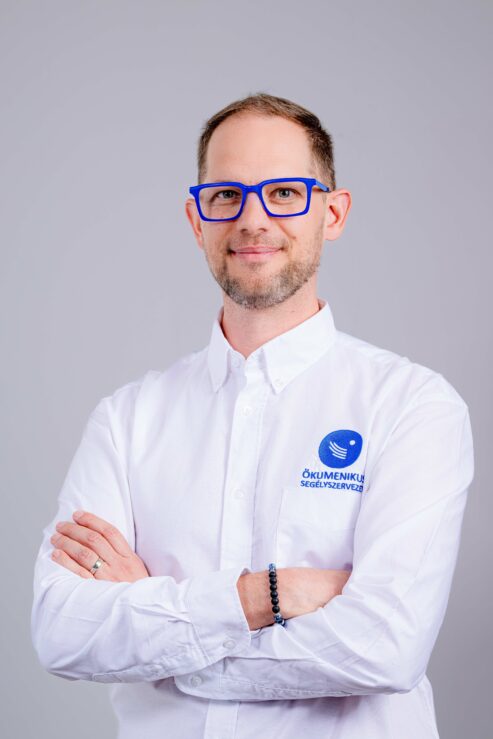
The assembly also marked an important milestone in the generational transition that has been underway within the organisation’s leadership for several years. Following the approval of the 2025 annual report, László Lehel, who has led the organisation since its establishment in 1991, thanked the assembly for its continued trust and announced that, after three and a half decades, he would hand over the baton. Confirming the prior recommendation of the Supervisory Board, the general assembly unanimously elected Kristóf Gáncs as the new President of HIA.

Chair of the Supervisory Board and Unitarian minister Ilona Szent-Iványi highlighted the message of unity and ‘oikumene’ that defined the organisation upon its foundation in 1991 and which remains alive today. She emphasised that, despite their differences, the founding churches joined forces under the shared value of Christian solidarity to launch what was then only a small team. She noted that this anniversary is not only an opportunity for reflection, but also for gratitude for the ever-strengthening cooperation through which HIA has become one of Hungary’s largest and internationally recognised humanitarian and development organisations.
She also expressed her gratitude for László Lehel’s three and a half decades of service. She stressed that it is an unquestionable achievement that the once small organisation has, over the past 35 years, successfully responded to countless humanitarian and social crises — including natural disasters, wars and pandemics — becoming a credible and defining actor in the field of professional humanitarian assistance. Acting as the extended arm of the churches and of Hungary itself, it has provided effective support to millions of people. While building a nationwide presence in Hungary, HIA has also enriched the Hungarian civil sector with numerous innovations as a respected member of the international humanitarian community.
Ilona Szent-Iványi underlined that the organisation’s carefully managed generational transition over recent years has always been guided by a strong sense of responsibility. This is reflected in the gradual involvement of former Director of Communications Kristóf Gáncs in the organisation’s operational leadership, first as Deputy President-Director and later as Executive Director. This responsible process ensures that the organisation’s original mission will continue with unwavering credibility, renewed momentum and a new chapter, while remaining true to its founding purpose.
Highlighting the new President’s commitment to community building — which he has regarded as his principal mission since joining the organisation — Szent-Iványi praised him in her speech.
“Coming from a multi-generational Lutheran family with a strong ecumenical spirit and extensive international studies behind him, Kristóf Gáncs joined HIA 18 years ago as coordinator of a youth awareness-raising programme. As the person responsible for introducing CSR (corporate social responsibility) approaches into the organisation, and as a recognised communications professional, he played a major role in transforming the cooperation of the founding churches into a community that transcends sectors, generations and political divides. This bridge-building role, rooted in ecumenical values, is just as essential today as modern communication capable of reaching younger generations. We ask for God’s blessing on his work in this new position as well,” concluded the Chair of the Supervisory Board.
Summary of HIA’s 2025 Report
In 2025, HIA’s domestic social and development work continued to be characterised by steady growth and expansion. Employees at more than 50 centres within its nationwide institutional network provide around 100 different services aimed at effectively easing the hardships faced by those in need. Last year, the National Aid Centre received 59,000 requests for assistance.
The organisation continues to place particular emphasis on children: through its “Kapaszkodó” (“Helping Hand”) programme, more than 4,150 children receive support for social inclusion across more than 40 institutions. Participation also continued in the “Catching-Up Settlements” programme, where support services are now provided at 27 local presence points for disadvantaged families, reaching more than 4,600 children and adults in 2025.
One of HIA’s key objectives is combating domestic violence and supporting victims of abuse. In a unique way within Hungary, it offers a wide range of services, from crisis intervention and reintegration support to prevention programmes. In 2025, safe shelter was provided to 514 victims of domestic violence, while staff at the National Crisis Management and Information Helpline handled 11,000 calls.
The organisation’s objectives continue to be strengthened through cooperation with numerous corporate partners. Some support the mission through fundraising initiatives, while others contribute through substantial IT support, energy-efficiency developments and labour market assistance.
In recent years, Hungarian Interchurch Aid has also taken on an increasingly active role in Hungarian education as a school operator. Since 2023, it has maintained the Vocational Technical School and High School of Biatorbágy, and in 2025 it also assumed responsibility for the István Bocskai Primary School in Páty. Its expanding domestic educational activities are coordinated by the Hungarian Interchurch Aid Foundation for Education.
The organisation’s international humanitarian work continued to be strongly shaped by efforts to assist those affected by the Russian-Ukrainian war that broke out in 2022, both within Ukraine and among refugees arriving in Hungary. In 2025, the number of people supported through the response exceeded 940,000, while the total funds directed towards assisting those suffering the consequences of the war surpassed USD 65 million.
During 2025, HIA also launched solidarity campaigns in response to several international humanitarian disasters, including aid efforts for victims of earthquakes in Myanmar and Afghanistan. Among the exceptional situations of 2025, the flood disaster in Eastern Transylvania stood out. In addition to helping hundreds of affected families, Hungarian Interchurch Aid also provided extensive support to local communities.
